
In this guide, we answer when do babies start babbling and when do babies start talking? The article covers the stages of early speech development, tips for parents to encourage language skills, understanding what’s normal in speech development and when to get help.
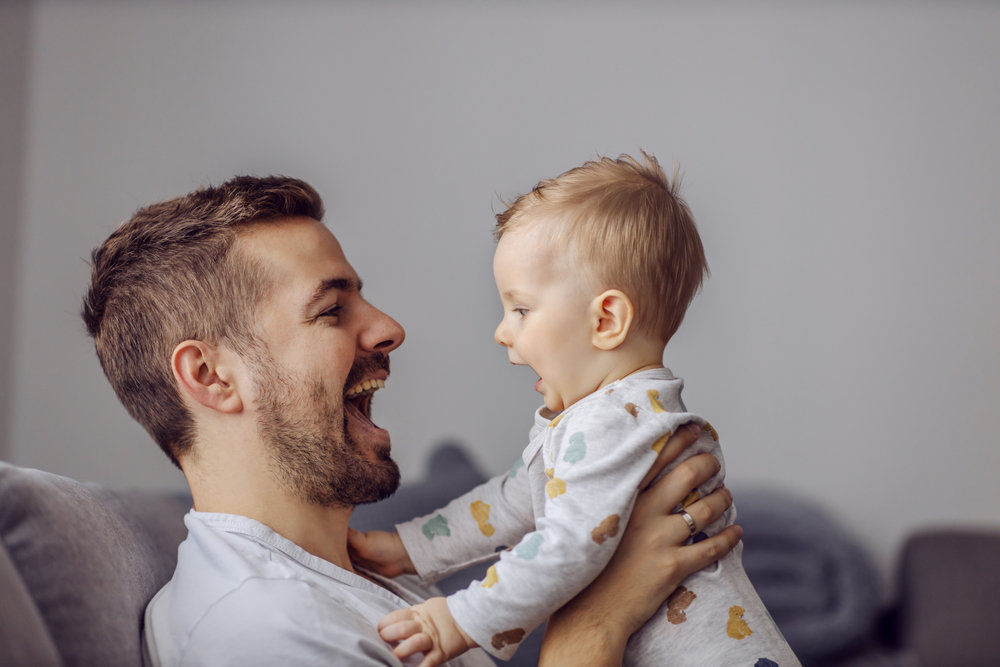
Table of contents
Table of contents
At a glance
- Babies usually say their first word between 10 and 14 months, though communication development begins much earlier with cooing and babbling.
- Speech develops gradually, with babies learning sounds, gestures, and simple words before forming short phrases around age two.
- Parents can encourage language development by talking, reading, singing, and responding to their baby’s sounds regularly.
- When do babies start babbling? If a baby isn’t babbling by 9 months or saying simple words by around 16 months, it may be helpful to seek advice from a health professional.
The journey towards speech begins long before a child speaks. Even newborns are learning about communication by listening to voices, recognizing tones, and responding with sounds.
Language development goes on through listening, interacting with parents and others caring for them and babbling.
Speech milestones
While every child develops at their own pace, here’s a general timeline for speech milestones:
| Age | Speech & Language Milestones |
| Birth–3 months | From birth, babies are crying, cooing, gurgling and sighing. They start to recogise their parents’ voices. From two months, babies typically start to smile. |
| 4–6 months | Babbling sounds like “ba” and “ma”. |
| 7–12 months | Babbling becomes more complex. A child may say their first word at 12 months. This could be Mama. While babies can make sounds with multiple syllables at 9 months, they still don’t have the motor skills to form words from their memory. |
| 12–18 months | Vocabulary grows to around 5–20 words and they speak more clearly. Words from their own experience such as ball or milk may be heard. |
| 18–24 months | Vocabulary expands quickly; combining two words like “more milk”. |
| 2 years | By two years old, toddlers may know around 50-100 words and can say two-word phrases. |
All children have a progress check at the age of two years old to assess whether developmental milestones are being achieved. You can read about what is involved in a progress check here.
Early signs your baby is learning to talk
Even before your baby says their first word, they are developing important communication skills. The behaviour highlighted below indicate your baby is learning how communication works.
Look out for these early signs your baby is learning to talk:
- Making eye contact during conversations.
- Imitating sounds or facial expressions.
- Responding to their name.
- Babbling.
- Repetitive sounds with short consonants and vowels e.g. “ma ma”, “ba ba”.
- Using gestures like pointing or waving.
What is babbling and when do babies start babbling?
While it may sound like it, a child’s babbling is not gobbledegook.
Your child’s early sounds are the building blocks of their verbal communication to help them form words.
When do babies start babbling? It is not uncommon for babies to babble from 4-6 months.
According to Speech and Language UK:
Most 6 months olds will:
- Turn towards a sound when they hear it.
- Be startled by loud noises.
- Watch your face and look into your eyes when you talk to them.
- Recognise your voice. For example, get excited when you are walking towards the cot and talking to them.
- Smile and laugh when other people smile and laugh.
- Make sounds to themselves, like cooing, gurgling and babbling.
- Make noises to get your attention like cooing and squealing.
- Have different cries for different needs. For example, one cry for hunger, another when they are tired.
Most one-year-olds will:
- Listen carefully and turn to someone talking on the other side of the room.
- Look at you when you speak and when their name is called.
- Make noises, point and look at you to get your attention.
- Babble strings of sounds, like ‘na-na’ and ‘go-go’.
- Take turns in ‘conversations’ where you talk and they babble back to you.
- Enjoy action songs and rhymes and get excited when sung to.
- Turn to look where you’re pointing when you show them something and say ‘look’.
- Start to say one or two recognisable words, for example ‘mama’, although these are not spoken very clearly.
When do babies start to talk?
On the subject of when do babies start to talk, most children will typically say their first real word between 10 and 14 months old.
How parents can encourage their baby to talk
There are many simple ways to support your baby’s speech development. By talking, reading and engaging with your baby daily, you can help build the foundation for strong language skills that will support their learning for years to come.
1. Hold your baby close and look at them as you talk to them
Babies love faces and will watch you and respond as you talk.
2. Talk to your baby often
Chat to your child about what is happening during their daily activities. For example, if you are going to feed them milk say “milk” or “milk time”. If you are putting them to bed say “sleep” and “bedtime”.
Constant exposure to words helps babies learn language patterns. You can speak in a sing-song voice to keep your baby’s attention.
3. Respond to babbling and repeat sounds your baby makes back to them
When your baby makes sounds, respond as if you’re having a conversation. This teaches them that communication is a two-way process. Your baby learns about listening and taking turns in a conversation.
4. Use visual cues
Use visual cues with your words to name what the child is seeing. For example, smile and point to your mouth and say ‘smile‘. Pick up an apple and say “apple”. Point to a ball and say “look at the ball”.
5. Read together every day
Reading books introduces babies to new vocabulary and sounds. Even very young babies benefit from looking at pictures while listening to your voice.
While reading a picture book to your child every day from birth can increase their vocabulary, parents can start even earlier than that by reading to their child while they are still in the womb. Check out this article on the benefits of reading to your child and how to read to a young child.
6. Use toys and books that make a noise
This helps your child develop listening skills.
7. Sing songs and nursery rhymes
Sing to your baby to help them understand rhythm, repetition and pronunciation.
8. Use gestures
Pointing to objects while naming them helps babies connect words with meanings.
9. Put a name to the face your baby is seeing
Say the name of the people whose faces your baby sees. E.g. for baby’s father say “Dada” or “Daddy”.
10. Limit TV, screen and radio time
The NHS recommends limiting your child’s time watching the TV as ‘playing and listening to stories is more helpful when they’re learning to talk. Switch off the television and radio – background noise makes it harder for your child to listen to you.’
At age 12-18 months
The NHS recommends that to help your child learn to speak by repeating any words correctly if your child gets any words wrong.
‘For example, if they point to a cat and say “Ca!” you should respond with, “Yes, it’s a cat”. Do not criticise or tell them off for getting the word wrong.
‘Increase your child’s vocabulary by giving them choices, such as, “Do you want an apple or a banana?”.
At 18 to 24 months
The NHS states ‘repetition helps your child to remember words. Repeat words, for example, “Where are your shoes?”, “Are you wearing blue shoes today?” and “Let’s put your shoes on”.
At 2 to 3 years
At this age, parents can help their child build sentences. The NHS states: ‘Try to reply using sentences that are a few words longer. For example, if they say, “sock off”, respond with “yes, we’re taking your sock off”.’
Why do babies develop speech at different times?
It’s common for babies to reach speech milestones at slightly different times.
Several factors can influence when a baby starts talking:
1. Personality and temperament
Some babies are naturally more observant and may spend longer listening before speaking.
2. Exposure to language
Babies who hear lots of conversation, songs and stories often build language skills faster.
3. Older siblings
Children with siblings may start speaking earlier because they are exposed to more daily interaction.
4. Bilingual households
Babies learning two languages may take slightly longer to start speaking but typically catch up quickly and benefit from bilingual development.
Should I be worried about my child’s speech development?
Some variation in speech development is normal, but certain signs may indicate a delay.
Consider speaking to a health visitor or GP if your baby:
- Does not babble by 9 months.
- Does not say simple words by 16 months.
- Does not respond to their name.
- Shows little interest in communicating.
Speech and Language UK has a free, confidential advice line with an experienced speech and language advisor for families in the UK.
During the 30-minute call, you can highlight your concerns and ask questions about your child’s development. The advisor can give you advice on how to support your child’s skills and let you know about other helpful services. You can book your appointment here.
The role of nurseries in language development
Early support can make a big difference in helping children develop strong communication skills.
High-quality early years settings like nurseries can play a major role in supporting speech development. Experienced practitioners encourage communication through:
- Storytime and group reading.
- Singing and music activities.
- Interactive play.
- Conversation during everyday routines.
If you’re looking for childcare that supports your child’s development and communication skills? You can find trusted nurseries near you on daynurseries.co.uk.
FAQs
When do babies start talking?
Typically, a child may say their first word at 12 months. For example ‘Mama’
When do babies start babbling?
It is not uncommon for babies to start babbling from 4-6 months. Typically between 7-12 months, babbling becomes more complex. While it may sound like it, a child’s babbling is not gobbledegook. Your child’s early sounds are the building blocks of their verbal communication to help them form words.
How many words does a two year old know?
By two years old, toddlers may typically know around 50-100 words and can say two-word phrases.

Have you started looking for a nursery near you?
Related Articles

Expert advice straight to your inbox
Join our growing community for clear, expert guidance on finding, choosing and paying for a nursery.
