Table of contents
The signs of autism in children, also known as Autism Spectrum Disorder (ASD), can be hard to spot but this article highlights autism symptoms in children.
ASD is a lifelong neurological condition. It mainly affects the way an individual communicates, socially interact with others and experiences the world around them. People have autism from birth. Autism symptoms children display can be more apparent depending on the individual, as the disorder affects everyone in different ways.
This condition comes in many forms, ranging from mild to severe on the spectrum. Young children have limited ways of expressing themselves. It is quite common for a young child to not be diagnosed with autism until they are older.
Signs of autism are also different in girls and boys. Girls often learn to socialise better than boys. Due to this ‘masking’, autism can be more difficult to spot in girls.
At a glance
- Autism can present differently in every child, but common early signs include difficulties with communication, social interaction and sensory processing. Examples include limited eye contact, not responding to their name, repetitive behaviours, sensitivity to sounds or textures, and delayed speech or language development.
- Signs of autism can be difficult to spot in very young children and may differ between boys and girls. Some children may not receive a diagnosis until they are older, and girls can be harder to identify because they may learn to mask or compensate for social difficulties.
- If parents have concerns, they should seek professional advice as early as possible. Diagnosis involves a referral for a specialist autism assessment, which may include observations, developmental history, reports from settings such as nurseries, and input from family members and professionals who know the child well.

Find a nursery near you
How do I know my child has autism?
Symptoms of autism in children vary in intensity and age and some children may not show all the signs.
If your child is showing one or more of the following signs, it may be time to seek professional advice.
Symptoms of autism in babies, toddlers and young children
• The child makes little or no eye contact.
• No response to their name or familiar voices.
• Shows no interest in or is not pointing at objects/events.
• Gets very upset or overreacts to sounds, smells and tastes.
• Does not smile back at you.
• Repetitive movements e.g. flapping hands, rocking body.
• Repeats activities, such as lining up toys in a particular order over and over.
• Says the same phrases.
• Uses few or no meaningful phrases.
• Displays self-injurious behaviour e.g.hand biting, pinching or scratching.
Signs of autism in older children
In older children, the symptoms of autism become more diverse. Autism symptoms can revolve around difficulties with socialising, speech, language and non-verbal communication.
See below for examples.
• Hard understanding other’s thinking and feelings.
• Finding it tricky to express their own feelings, needs and desires.
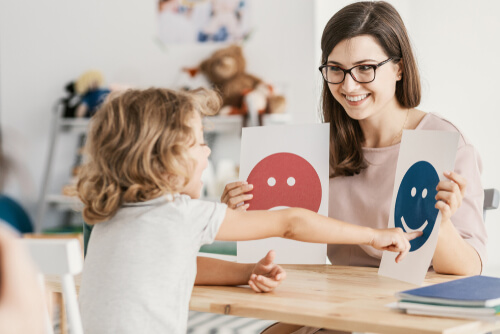
• Difficulties to understand facial expressions and other non-verbal communication.
• Taking what is said literally. Struggling to understand humour, irony and sarcasm.
• Getting upset over minor changes to their routines.
• Struggles to make friends and socialise.
• Prefers to be alone and shows disinterest in others.
• Regressing speech and language skills.
• Delayed speech and language skills.
• Cannot easily understand questions or simple directions.
• Avoiding eye contact.
Autism signs in a child can be difficult to diagnose, particularly in the first 24 months.
Rather than looking out for unusual behaviours, try to look for what common behaviours are absent. For example, instead of thinking your child’s screaming a lot is a sign, look out for atypical behaviour such as limited to no eye contact.
Babies are usually demanding and crave love from their parents. If this is not the case and your child is instead unresponsive to cuddling or being fed, this could be a warning sign.
Developmental milestones
As children get older they reach certain milestones. This includes smiling for the first time, learning to talk, crawl, walk and more.
Not reaching these milestones at the appropriate age can indicate your child is on the autistic spectrum.
Ambitious About Autism has published a downloadable Parents Toolkit . This includes a development checklist relating to speech and communication in children aged between 24 and 36 months old.
If you have concerns about your child not reaching milestones by a particular age, you can request an appointment with your child’s health visitor (for children under five), GP or other health professional.
Expert advice straight to your inbox
Join our growing community for clear, expert guidance on finding, choosing and paying for a nursery.

How do you diagnose autism in a child?
Children can be diagnosed as autistic from a young age.
If you think your child might be on the autism spectrum, talk to a GP, your child’s health visitor (if aged under 5 years old), other health professionals or their school’s Special Educational Needs (SENCO) staff.
When you speak to a health professional about your child, take the steps listed below.
• Write down and bring a list of the signs and symptoms of autism you have noticed.
• Talk to others who have interacted with your child before the appointment. Have they seen any signs?
• Be ready to take notes.
• Bring your child with you, if you think it might help.
There are tests online for autism. However these should not be used for accurate diagnosis. The only way to get an accurate diagnosis is through an autism assessment done by specialists.
Autism assessment for a child
When your child’s health visitor or other professional thinks your child should be assessed, they will make a referral to a team of autism specialists. You need a referral to be assessed for autism.
An autism assessment involves a team of autism specialists who check if your child has autism.
- They may ask questions about issues your child is having
- Watch your child interact with people in different settings
- Speak to people who know your child well (e.g. family members or your child’s teachers).
The assessment usually includes:
• Reports from all settings (e.g. nursery).
• An autism-specific developmental and family history.
• Observations in more than one setting.
• Communication, behaviour and mental health assessments.
• A physical examination.
• Tests and assessments for other conditions, where appropriate.
After the assessment, you will receive a report. It will outline if your child is autistic, what they may need support for and what they are good at.
Having your child diagnosed as autistic can be difficult, particularly if you are unfamiliar with the condition.
The National Autistic Society has a helpline where you can ask for advice and information about education.
FAQs
What are the signs of autism in children?
Common symptoms of autism in children are: They make little to no eye contact, don’t respond to their name, not showing any interest or pointing at objects or things happening around them, repetitive behaviour and not smiling back at you.
How do you know if a child has autism?
It can be difficult to diagnose a young child for autism as they have limited ways to express themselves and the absence of some behaviours may only be delayed. If they are showing signs, consider seeking advice and request an autism assessment. This is the only way to accurately diagnose for autism.
How does autism affect a child?
Autism is a neurological condition which mainly affects the way people communicate, socially interact and experience the world around them. In children, autism can cause developmental delays or regression.
How do you diagnose a child for autism?
To receive an accurate diagnosis your child needs to be referred for an autism assessment. During the autism assessment, specialists will ask questions about your child, watch the child interact with others and more.
Related Articles