Table of contents
One in five children under the age of two are affected by eczema in the UK, according to Allergy UK. Eczema, which often runs in families, currently ranks as the seventh most common condition in children.
Compared to adults, children are approximately eight times more likely to suffer from eczema due to the outer layer of protective skin being weak, allowing bacteria, irritants or allergens to cause inflammation and further impair the skin barrier.
Even though treatments are easily accessible to minimise symptoms, eczema is a lifelong condition that can cause daily discomfort.
Therefore, it is important to assess the situation at an early stage to treat the root of the condition.
There are seven types of eczema: atopic dermatitis, contact dermatitis, dyshidrotic eczema, neurodermatitis, nummular eczema, seborrheic dermatitis and stasis dermatitis. Atopic dermatitis is the most common form in children causing dry, cracked and itchy skin.
What is eczema?
Eczema is a non-life threatening, non-contagious inflammatory skin condition causing itchiness, with around two-thirds of children ‘outgrowing’ eczema as they get older. Increased awareness of certain skin care routines can limit severity of the symptoms.
Mainly occurring through irritants, for example soaps and detergents, environmental factors and allergens, the condition can vary from widespread to small patches and ordinarily takes place around the hands, elbows, knees, face and scalp.
Half of people suffering from eczema have a filaggrin deficiency (a skin protein) resulting in drier skin barriers and increased itchiness.
Eczema ‘flare-ups’ is a term used for periods when the eczema gets worse and can happen two to three times a month.
Secondary infections can develop from repeated scratching and can lead to disruption within day-to-day life such as lack of concentration at school. However, scratching can be prevented by regularly cutting your child’s nails and obtaining a pair of mittens.
What are the signs of infection?
- Improved severity of eczema
- Fluid build-up from the skin
- Swollen and aggravated skin
- Symptoms of a cold/flu
- Fatigue
- Temperatures rising and falling
- Dry yellow skin/ yellow spots in the eczema
Seek support from a dermatologist who will provide antibiotics for relevant care.
What are the signs and symptoms of eczema?
‘Pruritus’ is a term used for itching and the ‘itch-scratch cycle’ refers to continuous scratching until the skin begins to bleed or produce fluid.
According to the NHS, the main indicators of eczema are:
- Itchiness
- Dry skin
- Rashes
- Scaly patches
- Blisters
- Skin infections
- Discoloration of the skin
Your GP will be able to identify symptoms and give advice on treatment. The condition strongly ranges from minor to severe.
Different stages of eczema
Infants (first six months)
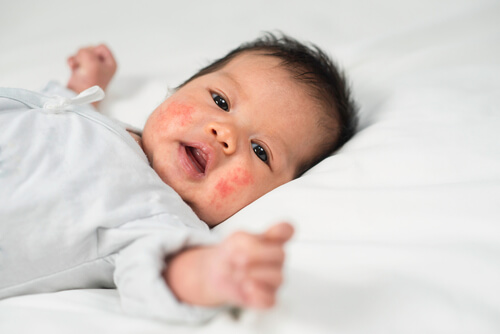
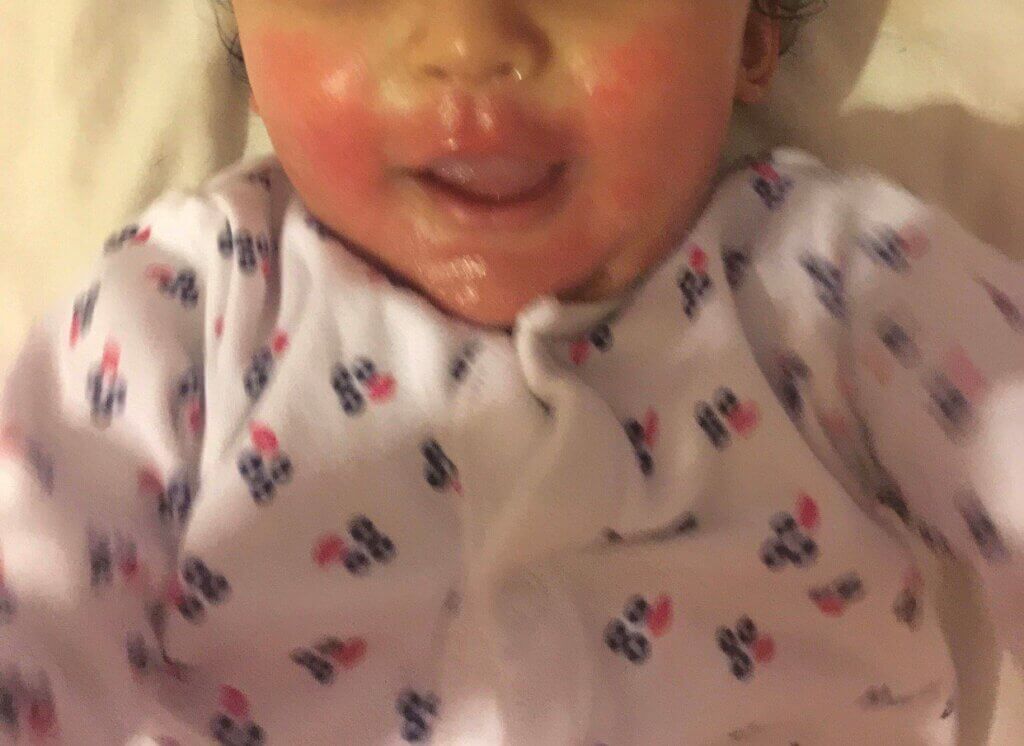
During this stage skin will appear red mostly on the face, cheeks, forehead and scalp.
Babies (six to twelve months)
Due to crawling, eczema usually spreads to your babies’ elbows and knees which at this stage could become infected, forming yellow spots or dry yellow skin.
Toddlers (two to five years)
Start of ‘Lichenification’, referring to thickened, hardened area of skin as a result of rubbing or scratching. Moreover, red bumps and patches are more likely to appear in the face, and in the creases of elbows, knees, hands, wrists and ankles.
Children (five plus years)
This stage can vary and some children only have hints of eczema on their hands while others appear in the creases of the elbows and knees.
Krina and Shiv’s Eczema Story
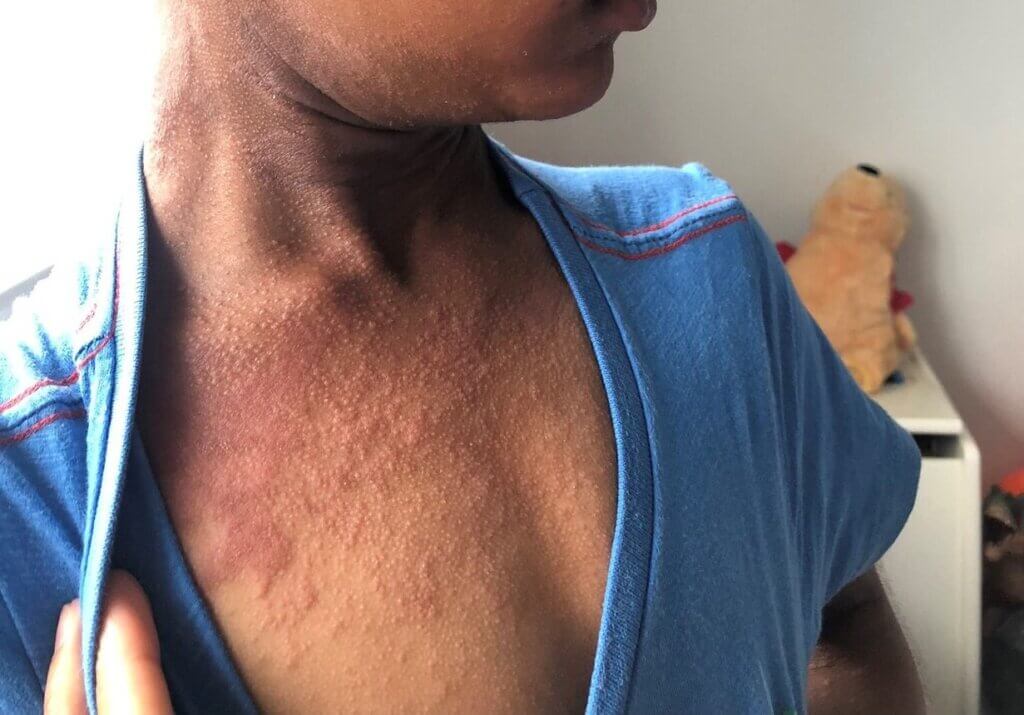
“My son was 5 months old when I first noticed red sore patches emerging on his face and body. I had no idea what it could be. It looked like an allergic reaction to something. I kept on applying coconut oil on his body to calm the irritation but the red patches were appearing everywhere! I took him to see a doctor who informed me it was eczema and prescribed topical steroids.”
You feel so helpless as a parent even when you feel you are doing everything you can
Krina, Shiv’s mother
“There would be blood stains all over his bed sheet and pillowcase in the mornings. One of us would sleep with him all night to prevent him from itching. In nursery, the staff would have to change his clothes daily as they would be covered in blood stains from all the itching. We later discovered Scratchsleeves which really helped with the cuts and bleeding but the eczema was still there.
We took my son to A&E once after his whole face got infected. It was red, sore, puffy, dry and weeping. His skin regularly became infected due to all the cuts and we were prescribed topical antibiotic steroids to deal with the infection and eczema flare up.
My son is now 6 years old and when his skin flares up, no amount of cream or oil gives him any relief
Krina, Shiv’s mother
My son is now 6 years old and when his skin flares up, no amount of cream or oil gives him any relief. When he was a baby/toddler I would moisturise him head to toe every 2 hours but that was still not enough. We always end up using topical steroids to calm it down which works a miracle for the duration we use it. However, as soon as we stop or reduce, it all comes back again!
We have tried everything! We have been through nearly 20 different emollient creams and various other oils and bath products, but nothing has worked!
The prolonged use of topical steroids is something as a parent I have been extremely concerned about. I have been applying topical steroids on his skin for 6 years! This cannot be the only way to treat severe eczema.”
Image credit: Eczema Society
Is there a cure for eczema?
Currently there is no cure for eczema, it is a chronic condition with stages of flare and remission. Unfortunately, people with a history of eczema will have a recurrence of itchy and dry skin.
Treating eczema
Treatments have been available for over fifty years to help reduce symptoms:
- Medical moistures (emollients) – prevents environmental triggers by hydrating the skin with water, softening it. For example, creams and ointments. Contact a pharmacist for advice because success rates differ. Ultimately, seal in moisture typically fifteen to twenty minutes a day strengthens the skin barrier and prevents future rashes.
- Bathing – used with an emollient at least twice a day, this will eliminate dirt and other external factors whilst also repairing the skin.
- Prescribed topical steroids – professional healthcare treatment sought through your local GP. Prompt assistance can help soothe the skin quickly and more effectively, reducing inflammation. However, side effects may include: thinning of the skin, mild stinging, acne, hair growth and changes of skin colour. Therefore, begin with the weakest effective treatment to control symptoms.
- Identify and reduce triggers – bodily triggers, environmental triggers, product triggers can cause flare ups so avoid these.
- Natural methods include bleach baths, cryotherapy and medical-grade honey. Seek advice from a doctor before use of these methods as they can be damaging to babies.
- Dietary changes – milk and eggs can cause eczema symptoms. But it is important that a baby has a healthy diet so consult your GP before making any alterations.
Psychological effects of eczema on children
Eczema can cause physical as well as mental health concerns.
According to the NHS, the psychological effects of eczema are:
- Lack of sleep – an imbalanced sleep schedule can hinder a person’s mood, behaviour and ability to concentrate. Subsequently, children can underperform at school because of difficulties keeping up with work. During an extreme flare-up the child should stay absent from school and the teacher should be informed of the condition.
- Bullying – Supporting your child is vital to overcoming bullying. Seek advice from the school.
- Lowered self-esteem – early development of social skills is important in childhood. Reassurance and support are necessary to aid the child’s confidence.
Do food allergies cause eczema?
In short no, foods do not cause eczema. However, certain foods can trigger a flare up and intensify eczema, showing a connection between eczema and food. Despite this, research has shown eczema can lead to a development of food allergies.
It is evident eczema weakens the skin barrier which allows food particles through the skin into the immune system. Immune cells attack these particles, leading to a food allergy and allergic reactions.
Eliminating food from a baby’s diet is generally unhealthy and will not cure eczema. It is not advised because it has potential to cause other health issues.
Helplines
The National Eczema Society
Website: https://eczema.org/
Helpline: 0800 4480818
Email: info@eczema.org
British Society for Paediatric Dermatology
Website: https://bspad.co.uk/
Helpline: 02071 886399
Email: hello@bspad.co.uk
Allergy UK
Website: www.allergyuk.org/
Helpline: 01322 619898
Email: info@allergyuk.org
Related Articles